
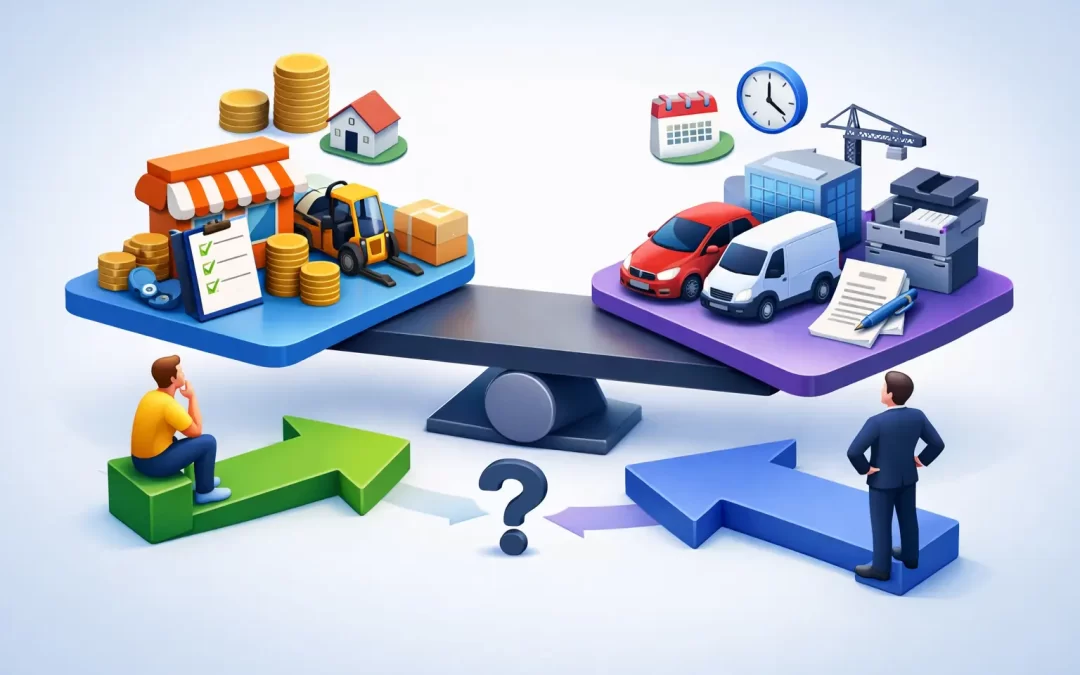
A new work ute, delivery van or vital piece of equipment should help your business move forward – not leave you second-guessing the finance contract. When weighing up hire purchase vs lease, the key difference is not simply the repayment. It is what happens to the asset at the end of the agreement, how much flexibility you need and how the structure suits your cash flow.
Both options can help Australian businesses acquire vehicles and equipment without paying the full purchase price upfront. Both can be tailored around the asset, loan term and business circumstances. Yet they are built for different priorities. Hire purchase generally suits borrowers who want a clear path to ownership. A finance lease can suit businesses that value lower regular commitments or plan to change assets over time.
The right answer depends on the asset, your expected usage, your GST and tax position, and where the business is heading. Here is how to make the comparison with confidence.
What is hire purchase?
Hire purchase is an asset-finance arrangement where the financier purchases the vehicle or equipment and hires it to you for an agreed term. You make regular repayments, usually over one to five years, and use the asset throughout the agreement.
Legal ownership remains with the financier until you have met the contractual obligations and made any final payment. Once the agreement is completed, ownership transfers to you. In practical terms, it is often a good fit when you intend to keep the asset for the long haul.
A deposit, trade-in or balloon payment may be available depending on the lender, asset and application. A balloon reduces the regular repayment by leaving an agreed amount due at the end of the term. It can assist cash flow, but it needs a plan: you will need to pay, refinance or otherwise settle that amount when it falls due.
For a plumber buying a ute fitted with tools and storage, or a business purchasing equipment expected to stay productive for years, ownership can be the deciding factor. Once the final amount is paid, the asset is yours to keep, sell or trade.
What is a finance lease?
With a finance lease, the financier buys the chosen asset and leases it to your business for a set period. You make regular lease rentals for the use of the asset. At the end of the term, there is usually a residual value – a pre-agreed amount reflecting the asset’s expected value at that point.
Unlike hire purchase, a finance lease does not automatically transfer ownership to you at the end. Depending on the agreement and lender options, you may be able to pay out or refinance the residual, trade the asset in, or enter into a further arrangement. The exact end-of-term options should always be clear before you sign.
A finance lease may suit a business that uses vehicles or equipment heavily and wants the option to update them regularly. For example, a growing courier business may prefer to review its vans every few years rather than hold ageing vehicles indefinitely. The residual can lower the lease rentals during the term, although it remains an obligation that must be dealt with at the end.
Hire purchase vs lease: the key differences
The most useful way to compare hire purchase and a finance lease is to look beyond the headline rate. The structure affects ownership, end-of-term decisions and how the finance supports your operation.
Ownership at the end
Hire purchase has a straightforward ownership outcome. Subject to meeting all repayments and final contractual amounts, you take ownership when the agreement ends. This provides certainty for borrowers who see the asset as a long-term business investment.
With a finance lease, the financier retains ownership during the lease. Your business has use of the asset, but the residual and end-of-term pathway need to be considered from the beginning. A lease can offer useful flexibility, but it does not offer the same automatic transfer of ownership.
Repayments and residual value
Regular repayments under either product are influenced by the asset price, deposit, trade-in, term, interest rate and fees. A residual or balloon may lower the regular amount, but it is not a discount on the overall commitment. It shifts a portion of the cost to the end.
Finance leases commonly include a residual value. Hire purchase can also include a balloon, subject to lender criteria. If lower monthly commitments are important, both structures may be worth considering – provided the final payment fits your expected cash position and the likely value of the asset.
Asset use and replacement plans
Hire purchase often suits assets you plan to retain well beyond the finance term. This can include specialised machinery, a truck with a fit-out designed for your operation, or a vehicle you maintain carefully and expect to run for many years.
A finance lease can make sense when replacement timing matters. If your business relies on newer vehicles for reliability, presentation or warranty coverage, the ability to assess your options at the end of the lease can be valuable. That said, replacing an asset is not automatic or cost-free, so it should be part of a planned finance strategy rather than an assumption.
GST, tax and accounting treatment
GST and tax treatment can differ between hire purchase and lease arrangements, particularly where assets are used partly for business and partly for private purposes. Eligibility to claim GST credits, deductions and depreciation depends on your circumstances and the way the facility is structured.
Your accountant or tax adviser should confirm the likely treatment before you proceed. A broker can help explain the finance structure and repayment options, but they should not replace tailored tax advice. Getting both perspectives early can prevent a structure that looks affordable now but creates avoidable complexity later.
Which option may suit your circumstances?
There is no universal winner. A good decision starts with what you need the asset to do for the business.
Hire purchase may be worth closer consideration if you want certainty that you will own the vehicle or equipment after completing the contract. It can suit businesses buying a dependable work asset, building long-term equity in their equipment, or wanting freedom to keep using the asset without an end-of-lease decision.
A finance lease may be worth considering if preserving regular cash flow is a priority and you want to keep future asset replacement options open. It can be particularly relevant for business vehicles, trucks and equipment with predictable replacement cycles.
For self-employed operators, the decision can also be shaped by income patterns. A seasonal business may need repayments structured around realistic cash flow rather than choosing a product solely because the monthly figure appears lower. The same applies to newer businesses: affordability should leave room for insurance, registration, maintenance, fuel and the ordinary costs of running the operation.
Questions to ask before choosing
Before agreeing to either structure, get clear answers to the practical questions. How long will you realistically keep the asset? What will it be worth at the end of the term? Can the business comfortably manage the residual or balloon if revenue is quieter than expected? Will the asset be used entirely for business, or will there be private use?
Also ask for the total amount payable, not only the regular repayment. Check whether the rate is fixed or variable, whether early payout is available and what fees may apply. Confirm the required insurance, the consequences of missed payments and whether the asset has any age or condition restrictions.
These details matter just as much as the product name. A well-structured agreement should be understandable, match the useful life of the asset and leave no surprises at settlement or at the end of the term.
Get finance guidance that fits the asset
Comparing finance products can feel time-consuming when you are also sourcing a vehicle, negotiating a purchase and running a business. An experienced broker can assess the asset, your trading position and the finance purpose, then compare suitable lender options rather than pushing a one-size-fits-all solution.
Auto Link Finance helps borrowers explore tailored vehicle and equipment finance options across a broad lender network, including solutions for more complex credit circumstances. The aim is to make the structure as practical as the asset itself.
Before you commit, set aside time to compare the end-of-term outcome as carefully as the repayment. The best finance option is the one that supports your work now and gives you a clear, manageable next step when the agreement finishes.